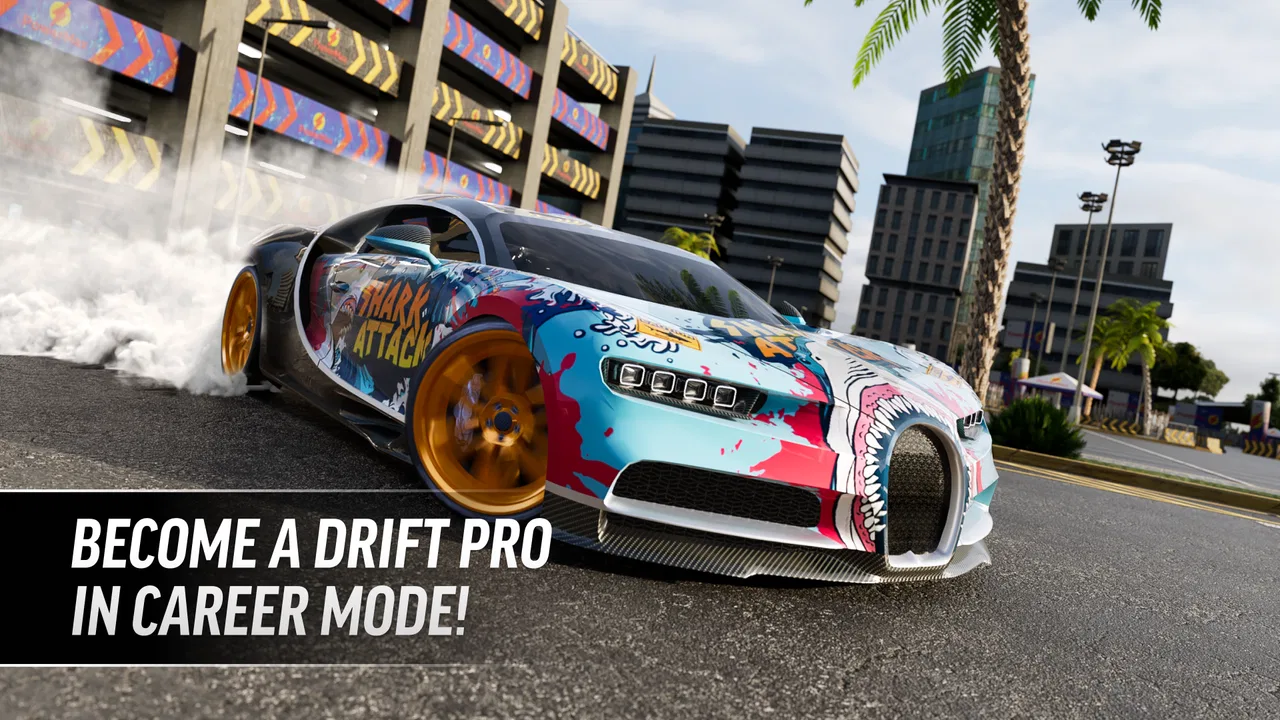
Drift Max Pro Car Racing Game
- 4.7
- Rating
- 100.00M
- Installs
- Free
- Price

 Analysis by App-foxy
Drift Max Pro is the kind of racing game I can open for a few minutes and still feel that I have done something, rather than simply watched a car move around a track. Its focus is drifting, so the main challenge is not just reaching the finish line. I have to control the slide, keep the car balanced, and decide when to stop correcting before a stylish turn becomes a crash. That makes it more demanding than a basic arcade racer, while remaining approachable enough for a first attempt.
Developed by Tiramisu, the game is free to start and is suitable for Everyone. It has been available since December 15, 2017, and its large player base is reflected in an average rating of 4.7 from around 2.1 million ratings, alongside over 100 million installs. Those figures do not replace personal experience, but they do suggest that the game has managed to stay attractive to a broad audience rather than serving only specialist racing fans.
My first impression is that this is best understood as a drift-focused mobile racer, not a full simulation. The cars are designed to feel lively and forgiving enough for touch controls, but the game still rewards timing and restraint. If you want a serious track simulator with detailed tuning menus and a long strategic career, this may feel light. If you want quick races where improving one corner can make the next session feel better, it has a much clearer appeal.
You May Also Like

 Blood Strike: 2.5 Anniversary
Blood Strike’s Loadouts Turn Every Drop Into a Tactical Gamble
A close look at Blood Strike’s custom loadouts: how fast access to signature weapons reshapes its battle royale rhythm, rewards preparation, and narrows the gap between fights.

 Pandora - Music & Podcasts
Pandora’s Music Is Easy to Start, but Harder to Recover
Pandora’s strength is its low-effort path from a seed to a station. Its weak spot is how much confidence it asks you to place in connection, setup, and quiet recovery.

 8 Ball Pool
 Is Built on Rivalries, Rematches, and Routine
A close look at the rivalries, rematches, shared routines, and unanswered safety questions that turn a quick pool match into a persistent mobile community.

 Samsung Music
’s Quiet Strength Is Playing What You Already Own
Its reach comes less from spectacle than from dependable access to a personal library. That simplicity is both the app’s strongest retention engine and its ceiling.

 AccuWeather: Weather Radar
AccuWeather Review: A Quick, Clear Forecast for Everyday Decisions
For everyday plans, the best forecast is the one you can understand quickly. AccuWeather makes rain timing, radar, and local conditions easy to act on, with a few trade-offs.

 Hill Climb Racing
Why Hill Climb Racing Still Turns Crashes Into One More Run
A tiny car, a bumpy hill and one more upgrade: Hill Climb Racing keeps resurfacing because its simple chaos makes every near-miss feel personal.
More From Our News Desk
View All News


What to expect when you begin
The central attraction is the sensation of holding a controlled slide. A normal turn asks me to brake, steer, and accelerate in a fairly familiar sequence. A drift asks for more judgment: I need to enter with enough speed to make the rear of the car move, then use steering and throttle carefully so the car continues along the curve instead of spinning or leaving the road. That small difference gives each course a learning curve even when the controls look simple.
I would not install this expecting a realistic driving lesson. The game presents racing through an arcade lens, where visible style and successful control matter more than reproducing every detail of real vehicle behavior. That is a strength on a phone because I can understand the objective quickly. It is also a limitation for players who want precise mechanical authenticity.
The most satisfying sessions are usually not the ones where I win immediately. They are the attempts where I finally connect two or three corners without breaking the slide. A short run can become a personal exercise in consistency: enter the first bend cleanly, avoid oversteering through the middle, and leave enough control for the next section. This gives the game more depth than its pick-up-and-play presentation initially suggests.
There is also a useful distinction between playing for completion and playing for mastery. A casual player can enjoy the spectacle of drifting and move on after a few attempts. A more committed player will start noticing entry speed, steering corrections, and the moment at which acceleration helps or hurts. I found that the game becomes more interesting when I stop treating every turn as a place to hold the control in one direction and start treating it as a sequence of small decisions.
Because the game is free, it is easy to try without making a commitment. However, free access does not mean every possible progression choice is equally frictionless. In-app purchases range from $0.89 to $54.99 per item, so I would approach the purchase options deliberately rather than tapping through them simply because a new car or improvement looks attractive. The useful question is whether I am enjoying the driving enough to continue, not whether buying something will instantly remove the learning curve.
The first setup should be simple and deliberate
The game supports devices running Android 8.0 or later. Before starting, I would make sure the phone has enough battery and that notifications are unlikely to interrupt a run. That sounds obvious, but drifting depends on continuous attention; a brief interruption at the wrong moment can turn a good attempt into a wall impact.
On the first launch, I recommend taking a moment to understand the control layout before chasing a score. The important thing is not to memorize every screen immediately. Instead, identify how steering is handled, how acceleration is controlled, and where braking or other driving inputs sit. Touch controls can feel awkward when I look at the car rather than the interface, so a short practice period is more useful than repeatedly restarting after mistakes.
I also prefer beginning with a conservative driving style. New players often try to create a dramatic slide as soon as a corner appears, but a smaller, stable drift teaches more than a spectacular spin. Enter the bend with manageable speed, make a modest steering input, and observe how quickly the car reacts. Once that movement feels predictable, increase the angle gradually.
One practical tip is to keep my thumbs relaxed. Tense, large swipes or abrupt taps make it harder to correct a car that is already moving sideways. Small inputs are easier to repeat, and repeatability is more valuable than a single lucky maneuver. This is particularly important on a phone, where the screen gives less physical feedback than a controller.
I would also avoid changing several things at once. If I alter my steering habit, acceleration timing, and vehicle choice during the same attempt, I cannot tell what improved the result. A better routine is to keep the setup steady for a few runs, focus on one corner, and then make one adjustment. That turns failure into information instead of making every crash feel random.
How to reach the first meaningful success
For a first-time user, meaningful success should not mean winning a difficult championship immediately. I would define it as completing a corner with the car still under control and exiting in a position that allows the next turn to begin cleanly. That moment shows that the player is learning the game’s rhythm rather than merely reacting to accidents.
Start by watching the road shape before initiating a drift. If I wait until the car is already deep into a sharp turn, I have less room to correct. A better approach is to prepare early, make a measured steering change, and use acceleration only when the car is beginning to point toward the exit. The goal is a smooth arc, not the largest possible sideways angle.
When the rear of the car starts moving farther than expected, my first instinct may be to make a strong opposite correction. In practice, that can create a second problem. Gentle countersteering gives the car time to settle, while a dramatic correction can send it in the opposite direction. I found that the best early lesson is to save a run with a small adjustment rather than trying to recover perfectly.
A realistic everyday scenario is a short break between tasks. I might have ten minutes while waiting for an appointment or before leaving home. Instead of beginning a long, complicated racing campaign, I can use that time to repeat one course section and work on a single turn. The game suits this routine because improvement can come from one cleaner attempt, even when I do not have time for a long session.
Another useful exercise is to aim for consistency instead of maximum style. Complete several runs while keeping the car on the road, then compare how often the same corner causes trouble. If one bend repeatedly ends the attempt, slow the entry and focus on the exit. This method feels less exciting than chasing a huge drift immediately, but it builds the control needed for later challenges.
Players who use a phone with a smaller screen may need extra care with finger placement. I would keep the display clear and avoid covering the area where I need to see the car’s position. If the controls feel crowded, changing my grip can help more than forcing faster reactions. The game’s challenge is already about timing, so visual obstruction only adds frustration that has nothing to do with driving skill.
Common confusion that can slow down new players
The first common misunderstanding is assuming that every successful drift requires maximum steering. It does not. A drift is useful only when I can guide the car through the corner and recover afterward. Holding an extreme angle may look impressive for a moment, but it often sacrifices the line needed for the next section. I get better results by asking where the car should be at the exit, then choosing the smallest input that can reach that position.
Another confusion comes from treating speed as the only measure of progress. Going faster can make a run feel exciting, but speed without a stable line usually produces more corrections and more crashes. In this game, a slightly slower entry that leads to a clean exit can be more valuable than a fast entry that leaves the car facing the wrong way.
It is also easy to mistake a failed drift for a problem with the vehicle. Sometimes the real issue is timing. If I begin the slide too late, no car adjustment can fully repair the corner. Before deciding that a car is unsuitable, I would repeat the same turn with an earlier, gentler input. This helps separate a control mistake from a genuine preference for a different driving feel.
New players may also wonder whether they need to spend money to enjoy the game. My advice is to play long enough to decide whether the drifting itself is satisfying. Purchases can be tempting, especially when progression presents a desirable car, but they cannot teach entry timing or make every corner automatically safe. The free starting experience is the right place to test whether the core driving loop fits your taste.
The rating of Everyone makes the game broadly accessible, but that does not mean it will suit every player. Someone looking for quiet, low-pressure play may find repeated crashes irritating. Likewise, a player who dislikes touch-based steering or prefers realistic motorsport rules may be happier with a different racing style. The age rating tells me who can access the game; it does not promise that the handling will match every age group or skill level.
Turning early practice into better runs
Once I can complete basic turns, I start paying attention to transitions. The difficult part is often not one isolated corner but the change from one direction to another. A car that leaves the first drift at an awkward angle has less time to prepare for the next one. I therefore try to finish each slide with the following section already in mind, rather than treating the end of a corner as a complete reset.
This is where replaying familiar sections becomes worthwhile. Repetition is not just a way to grind; it lets me test one variable at a time. I can enter earlier, reduce the steering angle, release acceleration sooner, or choose a safer line. After a few attempts, the difference between a random correction and a deliberate adjustment becomes much clearer.
A non-obvious advantage of this approach is that it reduces the emotional effect of failure. When I have a specific experiment in mind, a crash answers a question. For example, if I test whether a slower entry produces a better exit, the result is useful even when the run fails elsewhere. That mindset makes the game feel more like skill practice and less like a sequence of unfair surprises.
I would also resist spending all available progress on appearance or immediate excitement before understanding the handling. A new car can be appealing, but a vehicle that feels less familiar may make early practice harder. First learn what kind of movement you can control, then decide whether a different option adds enjoyment. This is a better use of attention than constantly switching and blaming the latest choice for inconsistent results.
The game’s multiplayer championship focus gives competitive players a reason to keep refining their runs, but I would approach that side after becoming comfortable with the basics. Entering competitive play too early can make normal learning feel like failure because other players’ results become the comparison point. Building a personal baseline first makes later competition more informative: I can see whether a mistake came from the course, the pressure, or my own decision.
For players who enjoy sharing a device with friends, the game can also work as a quick challenge in which each person tries to improve a run. The useful rule is to compare completed attempts rather than one lucky moment. A clean, repeatable drift is a better sign of control than a single spectacular slide followed by a crash.
Who should choose it, and who should skip it
I would recommend Drift Max Pro to someone who likes arcade racing but wants more involvement than simply steering around a circuit. It is especially suitable for players who enjoy practicing a technique, seeing small improvements, and returning to a familiar course with a new plan. The free entry point makes it easy to test, and the Everyone rating keeps the audience broad.
It is also a good fit for short mobile sessions. I can play casually, but the controls offer enough room for focused practice when I want to improve. That combination is its strongest quality: the game does not require me to treat every session as a serious event, yet it gives me reasons to pay closer attention when a corner keeps defeating me.
I would skip it if my priority is a deep simulation of real-world racing. The drifting is the star, and other aspects of motorsport take a supporting role. A dedicated simulator may offer more precise vehicle behavior, broader race strategy, or a stronger sense of authentic track driving. I would also look elsewhere if I dislike repeating the same maneuver until muscle memory develops.
Players who want a purely relaxing experience should know that the game’s appeal depends on control. A calm-looking course can become demanding when I try to maintain a long slide, and the free-to-play structure may occasionally draw attention toward optional purchases. Neither issue ruins the experience for me, but both are reasons to approach it with realistic expectations.
My next step after the first good run
After completing a clean drift, I would not immediately chase the hardest available objective. I would repeat the same run and try to reproduce the result. If I can do that, I would then improve one part: a smoother entry, a tighter line, or a cleaner exit. This progression keeps the focus on transferable control rather than luck.
Once the basic technique feels dependable, the next step is to explore the competitive side with patience. Multiplayer championships are more enjoyable when I understand how my driving choices affect the whole run. I can then decide whether I prefer safe consistency or riskier, more stylish attempts. That choice gives the game a personal rhythm instead of forcing every player toward the same definition of success.
My final view is positive, with clear boundaries. Drift Max Pro succeeds because it turns a familiar racing idea into a focused test of timing, steering, and recovery. It is free to play, runs on Android 8.0 and later, and has earned a 4.7 average across a very large audience, but its real value is found in the driving feel rather than the headline numbers. I like it most when I treat each corner as a small problem to solve.
If you want a mobile racer that can fill a short break and still reward serious practice, I think it is worth trying. Begin slowly, learn one turn, and avoid judging the game by your first spin. If you need realistic simulation, minimal repetition, or no purchase prompts at all, choose another type of racing game. For everyone else, the first clean, controlled exit from a difficult corner is the moment this game starts to make sense.
FAQs for Drift Max Pro Car Racing Game
01What are the device requirements for Drift Max Pro Car Racing Game?
Drift Max Pro is compatible with both Android and iOS platforms. For Android users, it typically requires version 5.0 and up, while iOS users should have iOS 9.0 or later. Ensure your device has sufficient storage space and a stable internet connection to enjoy all features smoothly.
02Is Drift Max Pro Car Racing Game free to play?
Yes, Drift Max Pro is free to download and play. However, it offers in-app purchases for items like car upgrades, customization options, and removing ads. While these purchases can enhance gameplay, they're not essential for enjoying the full racing experience.
03Can I play Drift Max Pro offline?
Drift Max Pro offers both online and offline gameplay modes. While you can enjoy the single-player experience offline, an internet connection is required for accessing certain features like multiplayer races, leaderboards, and daily challenges.
04Does Drift Max Pro support multiplayer racing?
Yes, Drift Max Pro includes a multiplayer mode where you can compete against other players worldwide. You'll need a stable internet connection to participate in multiplayer races, which adds a competitive edge and enhances the overall gaming experience.
05How can I customize my cars in Drift Max Pro?
Drift Max Pro offers extensive customization options. You can modify your cars with a variety of paint jobs, decals, and rims. Additionally, performance upgrades are available to enhance speed and handling. Customization allows players to personalize their cars for both style and performance.
Pros
- Stunning graphics with realistic car models.
- Intuitive controls enhance the gaming experience.
- Wide variety of cars and customization options.
- Multiple game modes for diverse challenges.
- Frequent updates with new content.
Cons
- In-app purchases can be quite costly.
- Ads can interrupt gameplay frequently.
- Requires a stable internet connection.
- Game can be demanding on older devices.
- Limited offline features available.

Drift Max Pro Car Racing Game
Gallery